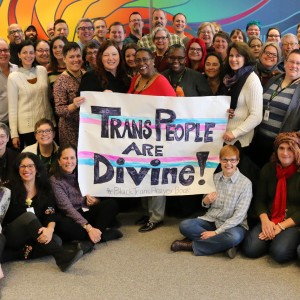
The Doctor of Ministry is an advanced professional degree that deepens students’ religious leadership in a variety of ministry settings, including community ministry, congregational ministry, social justice, activism, and entrepreneurial ministries, chaplaincy, and teaching roles. Coursework and reflection on lived leadership experience provide grounding points for the development of doctoral research and a thesis attentive to lived questions of theology and praxis.
Tightly woven student cohorts are led by faculty mentors who engage as a community of learners. Student-centered learning is at the heart of our program. Access to the Wiggin Library collection, the support of research librarians, and over 35 million books from academic and theological libraries across Illinois support student learning and research, with books available onsite or mailed directly to your door.
All cohorts meet together for an annual retreat in person or online. Courses meet online one night per week (Tuesday) for the entirety of a student’s program.
Students must hold a Master’s degree or equivalent and have three years of ministerial experience (ordained or lay) prior to application and matriculation.
The DMin degree requires 30 credits. The program is intended to be completed in three years, with two years of coursework and one year of research and writing. Contact the DMin Director for additional options.
Supervised Thesis Research I
Supervised Thesis Research II
* 1st-Year Students only
** 2nd-Year Students only
We look forward to welcoming you into Meadville Lombard’s Doctor of Ministry degree program! Prospective students must hold a Master’s degree from an accredited institution (MDiv or equivalent) and have engaged in the regular practice of professional ministry for at least three years (ordained or lay).
*Note: Accredited institutions are those recognized by the Council for Higher Education Accreditation or holding membership in the Association of Universities and Colleges in Canada. Prospective students may alternately hold a documented, educational equivalent of a bachelor’s degree from courses taken at an accredited institution. Exceptions to this policy may be allowed, depending on circumstances. Contact the Admissions Office with questions or to discuss your situation.